Projects ·
AI CORE: a shared foundation for assessing AI systems
A stable vocabulary, common requirements and assessment profiles help examine AI systems using traceable evidence. Assessment stays in your own workspace.
A good answer is not yet evidence
AI can produce convincing text or perform a complex task. The result alone does not reveal whether it used appropriate sources, respected permissions or acknowledged uncertainty. To rely on a system in real work, we need to trace what was examined and what supports the conclusion.
This is the need addressed by AI CORE, a public reference project maintained by AISYSTEMS. It provides shared terms and stable assessment profiles. It helps prepare an assessment in which questions, evidence and findings form a connected account rather than three unrelated lists.
Requirements and evidence belong together
A requirement states what should be examined. Evidence shows what was actually observed within a defined scope. A profile connects a control objective, method, expected material and criterion. The assessor explains whether the evidence is sufficient, where a shortcoming exists and what remains unverified.
The common security foundation addresses access, data protection and traceability. Two profiles build on it: Audit AI INDUSTRY for editorial workflows, and Security of AI assistants and agents with tools for systems that use tools and perform actions.
Three steps in your own workspace
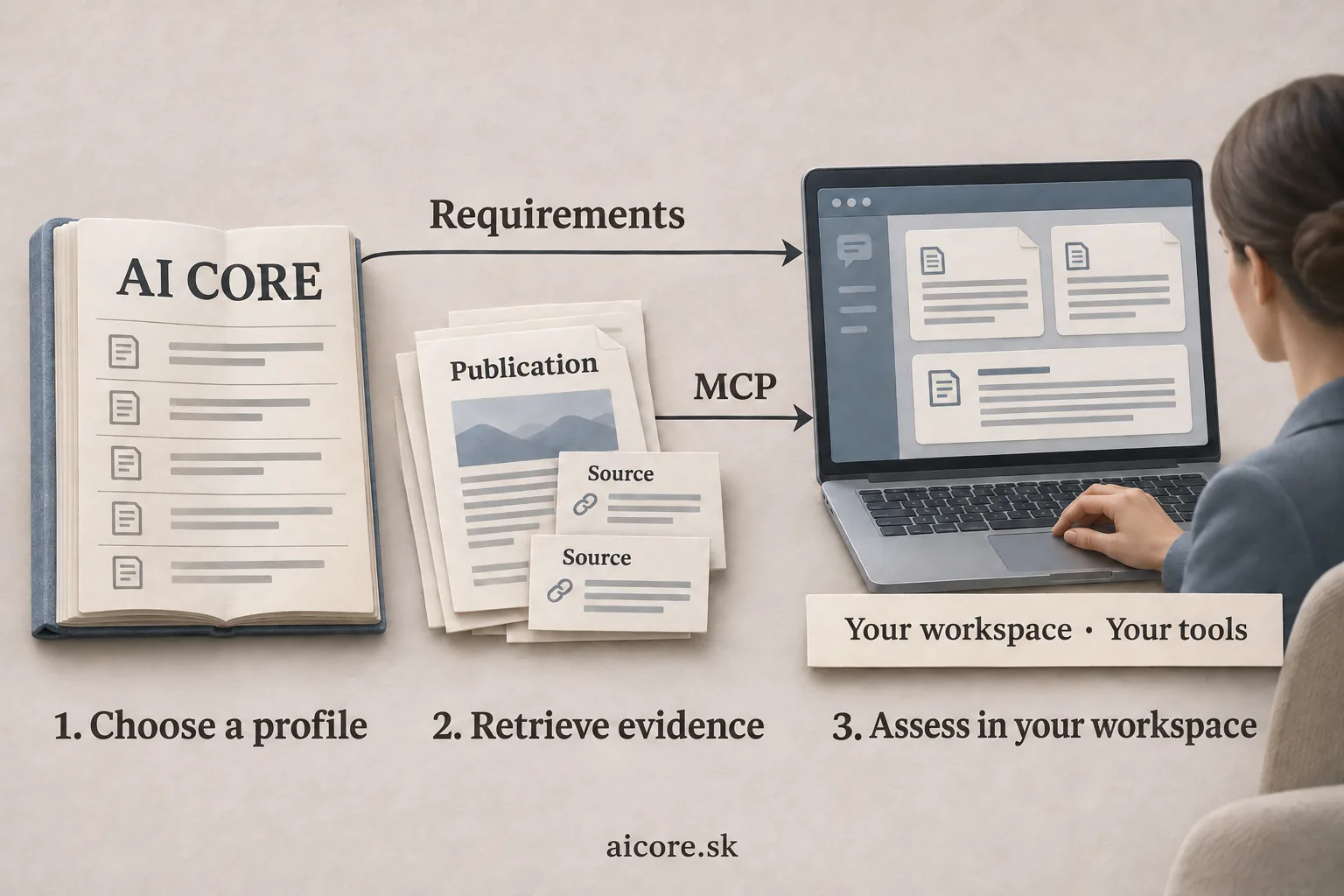
- Choose a profile. Define the subject, scope and exact version of requirements.
- Retrieve evidence. Collect available documents and observations, recording their origin and time.
- Assess the result. Compare evidence with requirements and openly identify missing verification.
You can work with a compatible AI assistant, your own software or expert review of documents. Private evidence does not need to be uploaded to the AI CORE website. The choice of method and final conclusion remain with the assessor.
AI INDUSTRY demonstrates the connection
The AI INDUSTRY magazine exposes selected evidence about published content and editorial workflows through MCP. An assessor can read it in observe-only mode and use an AI CORE profile without changing articles or initiating editorial workflows.
The interface makes evidence easier to obtain but does not guarantee completeness. A source count is not proof of truth, and a hash is not a certificate. Editorial metrics also do not replace a separate security assessment.
AI CORE provides a shared foundation for this work. It is neither an audit engine nor a certification authority. Its value lies in requirements and assessment boundaries that are readable, versioned and traceable.